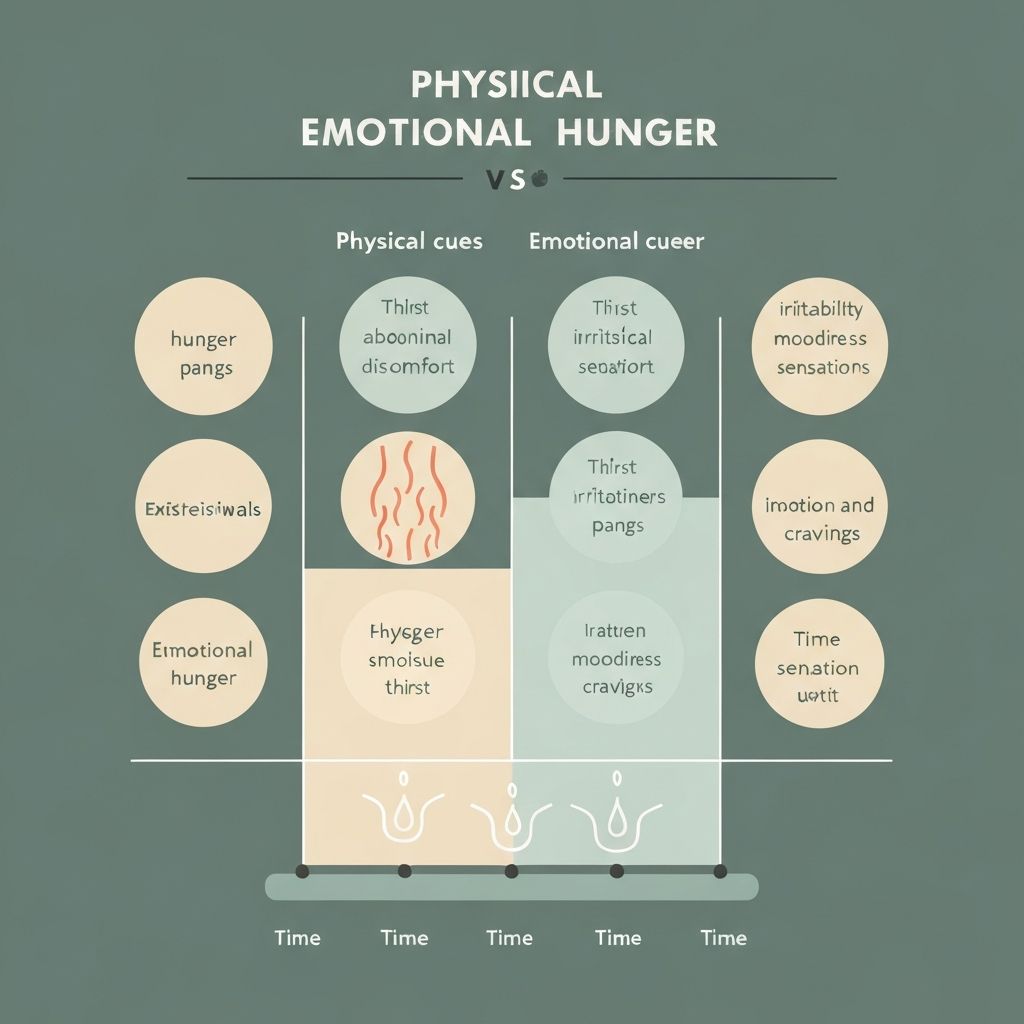
Understanding Two Distinct Forms of Hunger
Psychological and nutritional science recognizes distinctions between physiological hunger—the body's signal of nutritional need—and emotional hunger—the drive to consume food in response to emotional states. While these categories provide useful conceptual frameworks, neuroscientific research reveals that the distinction involves complex interactions between multiple brain systems rather than completely separate mechanisms.
Understanding the research on these hunger types illuminates how emotional states can override physiological hunger signals and how the same neurobiological systems can be engaged by both metabolic needs and emotional stimuli.
Physiological Hunger: Homeostatic Regulation
Physiological hunger emerges from the body's homeostatic need to maintain energy balance. Hormonal signals—particularly ghrelin elevation when energy stores are depleted and leptin reduction when caloric intake is insufficient—create the subjective experience of hunger that motivates eating behavior.
The hypothalamus contains specialized neurons that respond to these hormonal signals and generate hunger sensations that are typically diffuse and non-specific—an individual experiencing physiological hunger may accept various food options. Physiological hunger also follows predictable temporal patterns, increasing progressively as time since last eating increases.
The homeostatic hunger system evolved to maintain adequate energy intake and represents a relatively straightforward regulation system where peripheral hunger signals drive central nervous system responses promoting eating behavior.
Emotional Hunger: Non-Homeostatic Motivation
Emotional hunger, by contrast, operates through non-homeostatic mechanisms. Rather than reflecting energy deficiency, emotional hunger emerges from emotional states and is often characterized by craving for specific foods rather than hunger for food in general.
Emotional hunger frequently arises suddenly in response to emotional triggers—stress, sadness, boredom—and is not preceded by the typical progressive increase in hunger signals characteristic of physiological hunger. Importantly, emotional hunger can occur even when the individual has consumed adequate calories and possesses normal hormonal hunger signals.
The neurobiological basis of emotional hunger reflects engagement of reward system pathways, emotional processing brain regions, and learned associations between emotional states and particular foods rather than homeostatic energy regulation mechanisms.
Neurobiological Overlap and Interaction
While conceptually distinct, physiological and emotional hunger involve overlapping neurobiological systems. Both converge on common appetite-regulating centers in the hypothalamus. Both engage the reward system dopamine pathways. Both involve the prefrontal cortex in translating hunger motivation into eating behavior.
Research demonstrates that emotional states can alter hormonal hunger signals—stress can elevate ghrelin and reduce leptin sensitivity even when energy stores are adequate. Conversely, physiological energy depletion impairs emotional regulation capacity and increases vulnerability to emotional eating patterns. The systems interact bidirectionally rather than operating independently.
This interaction explains why individuals experiencing emotional hunger may have altered hormonal hunger signals. The emotional state doesn't operate in isolation but rather produces physiological changes that engage the same homeostatic hunger systems activated by actual energy deficit.
Research Methods for Distinguishing Hunger Types
Psychological research has employed various methodologies to differentiate emotional from physiological hunger. Self-report questionnaires assess subjective aspects—specificity of food desire, onset characteristics, satiation patterns. Physiological measures assess hormonal hunger signals (ghrelin and leptin levels) and energy deficit status.
Brain imaging studies reveal distinct activation patterns: emotional hunger activates reward system regions and emotional processing areas more prominently than physiological hunger, while physiological hunger shows greater hypothalamic activation in response to satiety-related hormonal signals.
Behavioral studies document differences in eating patterns: individuals in emotional hunger states show less adherence to typical satiety cues and greater sensitivity to food cues and emotional triggers. However, the complete separation of these patterns varies across individuals and contexts.
Individual Differences in Hunger Type Expression
Research identifies substantial individual differences in how readily emotional states produce eating motivation. Some individuals show prominent emotional eating responses to stress, while others show minimal emotional influence on eating. These differences reflect variations in emotional regulation capacity, learned associations between emotions and food, and possibly genetic variation in reward system sensitivity.
Developmental factors influence these patterns—childhood experiences with food in emotional contexts can establish strong learned associations that persist into adulthood. Cultural influences shape which foods become associated with emotional regulation and comfort.
Understanding these individual differences reveals that emotional versus physiological hunger distinction operates differently across people. What distinguishes emotional hunger for one individual may not apply equally to another, reflecting the complex interactions among neurobiological, developmental, and cultural factors.
Integration: A More Nuanced Understanding
Contemporary research suggests that the distinction between emotional and physiological hunger, while conceptually useful, represents an oversimplification of complex neurobiological reality. Rather than completely separate systems, emerging evidence supports an integrated model wherein emotional states influence physiological hunger regulation through multiple neural and hormonal pathways.
In this integrated framework, what appears as pure emotional hunger reflects emotional modification of the same homeostatic systems regulating physiological hunger, while physiological hunger can be modulated by concurrent emotional states and psychological factors.
This understanding illuminates how emotional states reliably influence eating behavior—not through a completely separate emotional system but rather through effects on the fundamental physiological hunger regulation systems through which all eating behavior emerges.
Conclusion: Research Perspectives on Hunger Types
Research on emotional versus physiological hunger reveals both meaningful distinctions and significant neurobiological overlap. While these categories provide useful conceptual frameworks for understanding eating behavior, neuroscientific evidence indicates that the distinction involves complex interactions among reward systems, emotional processing regions, and homeostatic regulation mechanisms.
Understanding these distinctions and interactions provides important foundation for appreciating how emotional states influence eating behavior through engagement of fundamental physiological hunger regulation systems.
Educational context: This article presents research on hunger distinctions and related mechanisms. It provides scientific information without offering personal recommendations or medical advice. Understanding these mechanisms supports informed appreciation of hunger-related eating behavior.