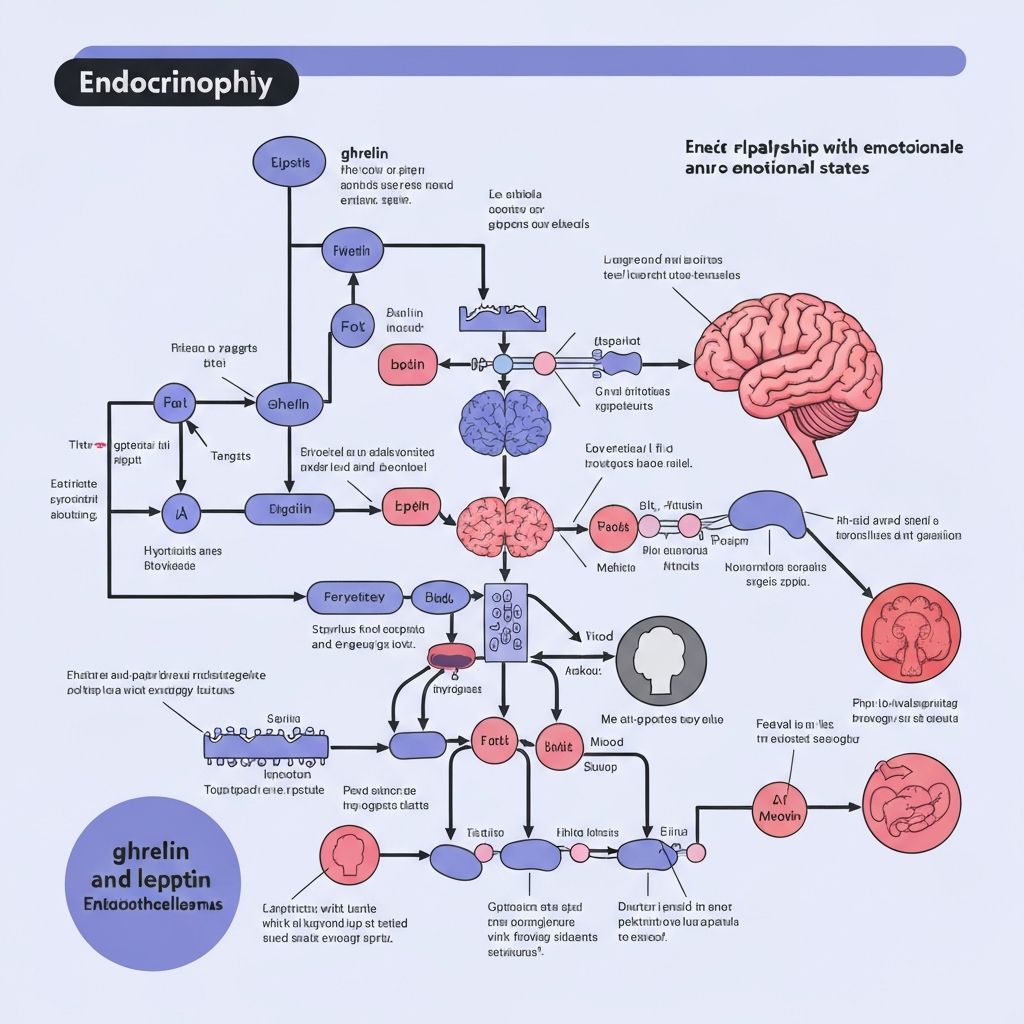
Two Key Appetite-Regulating Hormones
The body's appetite regulation operates substantially through hormonal signaling between peripheral tissues and the brain's appetite-controlling centers. Two hormones—ghrelin and leptin—play particularly central roles, providing the brain with critical information regarding energy stores and metabolic status.
Research over the past two decades has revealed that both of these appetite-regulating hormones are sensitive to emotional and psychological states. Emotional responses don't simply trigger eating through psychological motivation; they produce measurable changes in the very hormonal systems regulating physiological appetite. This convergence of hormonal and emotional influences on appetite represents a crucial mechanism through which emotions translate into altered eating behavior.
Ghrelin: The Hunger Hormone
Ghrelin is produced primarily in the stomach and signals energy deficiency to the brain, promoting appetite and food-seeking behavior. Ghrelin elevation typically occurs with fasting or energy deficit, creating subjective hunger sensations that motivate eating. In this role, ghrelin supports homeostatic energy balance.
However, research demonstrates that ghrelin secretion also responds to psychological stressors and emotional states. Studies show that acute stress frequently elevates ghrelin levels, and chronic stress can maintain elevated ghrelin despite adequate energy stores. This means that emotional stress produces hormonal changes that mimic the body's response to actual energy deficiency, creating hunger sensations in the absence of metabolic need.
Additionally, ghrelin elevation in response to stress appears to enhance preference for calorie-dense, highly palatable foods. The combination—elevated ghrelin from stress plus preference for reward-intensive foods—creates particularly strong conditions for increased eating during emotional distress.
Leptin: The Satiety Hormone
Leptin is produced by fat tissue and signals energy sufficiency to the brain, promoting satiety and reducing appetite. When leptin levels are adequate, individuals feel satisfied after eating and show reduced motivation for additional food consumption. Leptin elevation typically occurs with adequate energy stores and serves as a signal promoting cessation of eating.
However, emotional stress and negative emotional states can reduce leptin sensitivity—a condition termed leptin resistance. Even when leptin levels are adequate, the brain's responsiveness to leptin signaling may be reduced, particularly during psychological stress or depression. This creates conditions wherein despite adequate energy stores and normal leptin levels, individuals may fail to experience typical satiety signals.
The combination of stress-elevated ghrelin and stress-reduced leptin sensitivity creates a powerful neurobiological environment promoting increased appetite and eating. Normal satiety signals become less effective precisely when emotional conditions are promoting increased ghrelin-driven hunger motivation.
Stress-Induced Hormonal Dysregulation
Research on the hormonal effects of chronic stress reveals systematic dysregulation of ghrelin and leptin signaling. Studies consistently demonstrate that individuals experiencing chronic psychological stress show elevated baseline ghrelin levels and reduced leptin sensitivity compared to individuals with lower stress levels.
Importantly, these hormonal changes persist beyond acute stress periods. Individuals with chronically elevated psychological stress show enduring changes in ghrelin and leptin regulation that create sustained conditions promoting increased appetite and eating. The body's appetite regulation system becomes recalibrated toward increased hunger and reduced satiety signals.
This hormonal recalibration helps explain why stress-related weight gain is so common and persistent. The underlying hormonal changes create conditions wherein normal eating in response to physiological signals results in greater overall intake. Individual motivation or willpower cannot easily override dysregulated hormonal signals.
Depression and Appetite Dysregulation
Depression and depressive symptoms correlate with particularly pronounced alterations in ghrelin and leptin signaling. Research shows that depressed individuals frequently display elevated ghrelin despite adequate energy stores and altered leptin sensitivity. These hormonal changes contribute to the appetite disturbances commonly observed in depression.
Interestingly, depression can produce bidirectional appetite changes—some individuals with depression show increased appetite while others show decreased appetite. This variation appears partly related to depression subtype and partly to individual differences in hormonal responsiveness to mood disturbance.
The hormonal changes accompanying depression provide physiological basis for understanding depression-associated eating pattern changes. Rather than purely psychological effects on eating, depression produces measurable hormonal alterations that directly influence appetite regulation systems.
Sleep Disruption and Hormonal Effects
Sleep represents a critical regulator of ghrelin and leptin secretion. Sleep disruption—whether insufficient sleep duration or poor sleep quality—reliably produces elevated ghrelin and reduced leptin effectiveness. Even modest sleep restriction of a few hours per night produces measurable hormonal changes promoting increased appetite.
Since emotional distress frequently disrupts sleep, the sleep disruption accompanying stress creates additional hormonal disruption of appetite regulation. The combination of direct stress effects on ghrelin and leptin plus indirect effects through sleep disruption produces compounding dysregulation of appetite control systems.
This explains why individuals experiencing psychological stress combined with resulting sleep disruption frequently report substantially increased appetite and difficulty with portion control. The hormonal environment created by stress and sleep disruption provides physiological basis for these appetite changes.
Food Composition and Hormonal Responses
Research demonstrates that different macronutrients produce different hormonal responses. Protein and fiber-containing foods promote greater leptin signaling and stronger satiety responses. Conversely, highly refined carbohydrates and foods high in added sugars produce greater ghrelin elevation and weaker satiety responses.
Interestingly, the preference for high-calorie, low-nutrient foods during emotional eating may be partly explained by these hormonal effects. Foods chosen during emotional eating often include refined carbohydrates and added sugars, which produce hormonal patterns that promote continued eating despite adequate caloric intake. The preference for these foods during emotional states may reflect partly the reward system engagement and partly differential hormonal signaling.
Understanding these hormonal dynamics reveals that the specific foods consumed during emotional eating reflect not random choice but rather foods that produce particular hormonal and reward system effects.
Individual Differences in Hormonal Sensitivity
Research identifies considerable individual variation in ghrelin and leptin responses to stress and emotional states. Some individuals show pronounced hormonal dysregulation in response to stress, while others show more modest effects. These individual differences partly reflect genetic variation in hormone production and receptor sensitivity, and partly reflect learned patterns through experience.
Individuals with histories of using food for emotional regulation show more pronounced stress-induced hormonal dysregulation, suggesting that learned associations and behavioral patterns interact with physiological hormone production to influence overall appetite regulation. This demonstrates the complex interplay between learned psychological patterns and physiological hormone systems.
Understanding these individual differences reveals that stress-induced eating patterns reflect not universal hormone responses but rather the interaction between universal hormonal mechanisms and individual differences in hormone sensitivity and learned emotional-eating associations.
Conclusion: Hormones in Emotional Eating
Ghrelin and leptin provide physiological pathways through which emotional states directly influence appetite regulation. Stress and negative emotional states produce measurable changes in these hormones—elevated ghrelin and reduced leptin sensitivity—that create physiological conditions promoting increased appetite and eating.
These hormonal mechanisms represent one of several converging pathways through which emotions influence eating behavior. Alongside reward system activation, prefrontal cortex impairment, and learned associations, hormonal dysregulation contributes to the reliable observation that emotional states reliably alter eating patterns.
Understanding these hormonal pathways reveals that emotion-driven eating reflects not psychological weakness but rather engagement of fundamental physiological systems through which emotional states influence eating behavior.
Educational context: This article presents research on hormonal mechanisms in appetite regulation. It provides scientific information without offering personal recommendations or medical advice. Understanding these mechanisms supports informed appreciation of hormone-related eating behavior.